



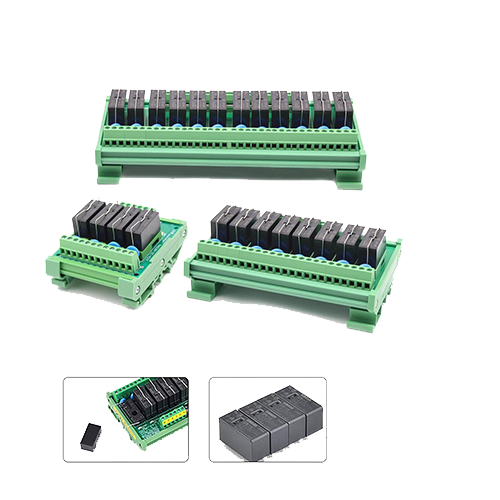
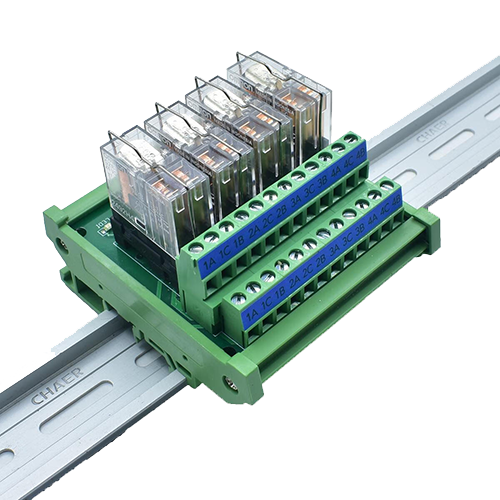
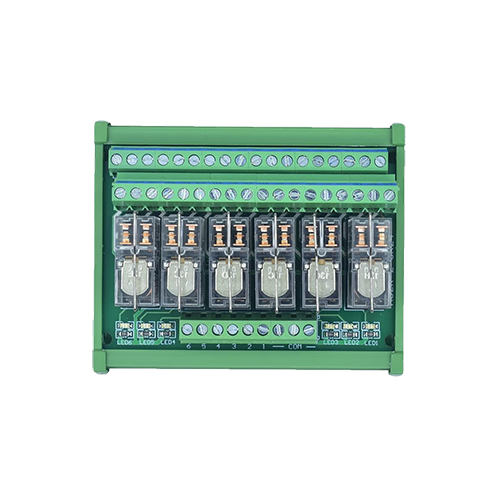
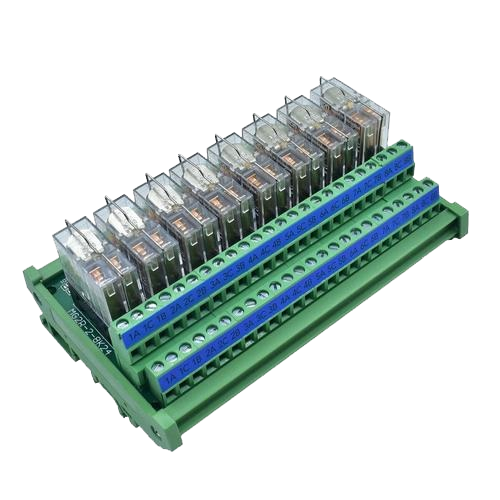
The industrial relay module integrates multiple relays (typically electromagnetic or solid-state relays) into a standardized module. It serves as a bridge between controllers (such as PLCs, microcontrollers, DCS) and high-power field loads (like motors, lights, heaters, solenoid valves), enabling low-voltage control of high-voltage circuits, signal isolation, and channel expansion.
The core advantages of industrial relay modules
1. The industrial relay module integrates multiple channels into one, with standardized dimensions (such as 8 channels with a width only equivalent to 2-3 independent relay units), reducing cabinet space and maintaining a neat layout.
2. The installation efficiency of industrial relay modules is extremely high. One click insertion into the standard guide rail, completing the physical installation of multiple relays at once.
3. Simple and standardized wiring. All input (coil) terminals and output (contact) terminals are centrally arranged on both sides, with clear strong and weak electrical zoning, and support for batch wire pressing.
4. High reliability. Adopting unified high-quality industrial grade components, optimized internal layout, and strong anti-interference ability. There are few connection points, and the risk of poor contact is low.
5. Low overall cost. Although the unit price of a module may be higher than the sum of individual relays, it greatly saves time and labor costs in design, installation, debugging, and maintenance.