



Power Monitoring Instruments and Intelligent Power Distribution Systems
#news ·2026-05-19 20:09:37


Over 80% of the electricity generated by the power grid is consumed by end-users. Establishing an intelligent power distribution system at the user end enables networked and intelligent transmission, distribution, control, protection, and management of electricity between power transformers and electrical equipment. This ensures more reliable, safe, efficient, and environmentally friendly electricity usage. As secondary components of switching devices in the power distribution system, smart power meters perform functions such as measuring and monitoring electrical parameters, metering and managing energy consumption, diagnosing and recording electrical faults, and controlling and protecting equipment operation. The intelligent power distribution system connects numerous communication-enabled control devices and smart power meters to computers, achieving centralized data acquisition, processing, monitoring, analysis, scheduling, and other intelligent management functions.
The system generally adopts a three-layer network distribution structure, namely the station control management layer, network communication layer, and on-site equipment layer.
The station control layer consists of system software and hardware devices, such as industrial computers, printers, UPS power supplies, etc. The communication layer consists of servers, communication gateways, human-machine interfaces, etc. The on-site equipment layer consists of protective devices, electrical switches and control equipment, power monitoring instruments, etc. Instruments not only bear the responsibility of collecting data, but also serve as one of the terminal components for executing backend control commands.
As the secondary element of the circuit breaker, the power monitoring instrument is configured differently in different applications. See figure:
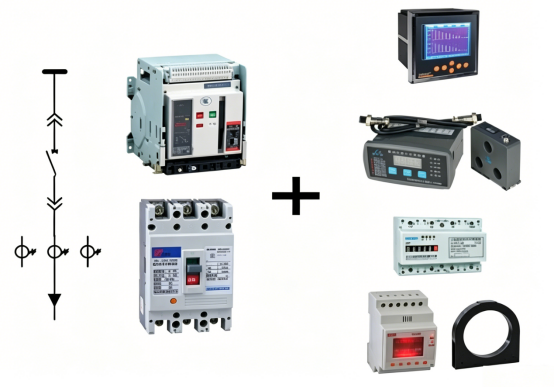
(1) Circuit breakers and monitoring instruments can be configured to measure various electrical parameters, analyze harmonics, and measure electrical energy. Through I/O modules, circuit breaker opening and closing and alarm status can be collected, and circuit breaker opening and closing can be controlled. It can greatly reduce electrical failures.
(2) The configuration of circuit breakers and protective instruments (motor controllers), combined with contactors, provides functions such as measuring electrical parameters, overload protection, unbalance protection, and locked rotor protection. Ensure the normal operation of the motor and improve production efficiency.
(3) Circuit breakers and safety instruments (residual current fire monitoring instruments) are configured to monitor circuit leakage current. If the set value is reached, an alarm output will be triggered. After confirmation by the fire department, the circuit breaker can be tripped through instructions to prevent electrical fire accidents caused by short circuits.
(4) Circuit breakers and electrical energy management instruments can be configured to measure electrical energy separately, and the use of energy can be counted by air conditioning, power, lighting, and special electricity items, making it convenient to analyze the causes of high consumption and propose measures to reduce consumption.
Of course, the above configuration requirements can also be achieved with a single instrument for power monitoring, energy management, and electrical safety, thereby reducing the number of instruments, facilitating user selection, and saving investment.