



Why use terminal block modules in industrial automation
#news ·2026-04-25 18:35:12


With the emergence of terminal block modules,they offer numerous advantages: time-saving, space-saving, cost-effective, reliable connections, neat wiring, efficient maintenance, safe isolation, flexible expansion, and effectively addressing pain points such as on-site vibration, interference, complex wiring, and frequent maintenance. The use of terminal block modules in industrial automation control cabinets is becoming increasingly widespread.
1.Standard terminal block vs terminal strip
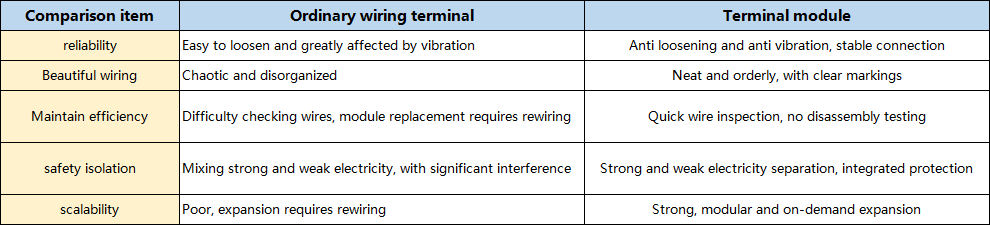
2.Compared with ordinary terminals, the terminal module has the following detailed advantages:
(1)Reliable connection, anti vibration and anti loosening
The industrial environment is harsh: vibration, temperature difference, and high dust. Direct wiring is prone to loosening and oxidation, leading to poor contact, heating, and even shutdown.
Advantages of terminal block: The screw/spring structure has strong locking force, vibration resistance, anti loosening, stable contact resistance, and ensures continuous and reliable transmission of signals and power.(2)Regular wiring to improve efficiency
There are many and miscellaneous wires in the control cabinet: PLC, sensors, actuators and other cables are dense, and directly connecting modules is prone to confusion and wiring errors.
Advantages of terminal block:
Centralized transfer: All external cables are first connected to the terminal block, and then short circuited to the PLC/module, with neat and orderly wiring.
Clear identification: The terminal number corresponds to the drawing, reducing the error rate and making installation and wire inspection faster.
High density cabling: DIN rail installation, space saving, compatible with compact control cabinets.
(3)Convenient maintenance and reduced downtime costs
Replace the module without damaging the cables: When the PLC/IO module is damaged, there is no need to move the external cables, only the short wires can be removed for replacement, greatly reducing downtime.
Easy to expand and renovate: When adding new equipment, the expansion points can be directly located on the terminal block without the need to reorganize the entire control cabinet circuit.
Separation of strong and weak electricity: Power lines (motors, power supplies) and signal lines (sensors, communication) are wired in different areas to reduce electromagnetic interference and protect weak electricity modules such as PLCs.
Isolation and protection: It can integrate functional modules such as relays, fuses, and surge protection to block high-voltage pulses and electrostatic interference, preventing damage to expensive control components.
Insulation safety: The terminal block shell is insulated, and standardized wiring can avoid short circuits and leakage risks, in compliance with industrial safety standards.
Unified interface: compatible with multiple wire diameters and wiring methods (screws/springs/direct insertion), suitable for different brands of PLCs, sensors, and actuators.
On demand expansion: modular design, stackable and combinable, allowing flexible configuration of IO points from small single machines to large production lines.3.Market application prospects of terminal module
Terminal module is the connection hub of industrial automation, which transforms the "messy, fragile, and difficult to maintain" direct wiring into a standardized solution that is "reliable, organized, easy to maintain, safe, and scalable". It is the foundation and key of control cabinet design. Driven by the explosion of industrial automation, energy storage/photovoltaics/new energy, the market will continue to grow steadily.